This article is essentially a continuation of Systems Thinking: An Operational Perspective of the Universe in which the Reinforcing and Balancing structures were developed. This article develops a set of frequently recurring structures resulting from various combinations of Reinforcing and Balancing structures. This article essentially represents an elaboration of the work of Senge (1990) and Pegasus Communications (1989-1996).
Note that all the archetype examples that were previously wired into this article are now accessible via theWay which is considered to provide a more comprehensive treatment of the archetypes, as well as a few additional ones, and used the "+" and "-" influence notation.
|
||
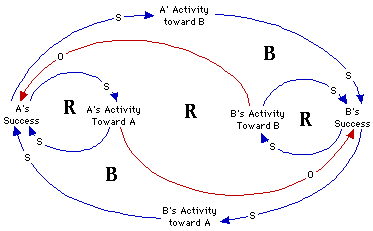
The Accidental Adversaries structure is a composed of three
reinforcing loops and two balancing loops. Overall system growth
is driven by a global reinforcing loop. Two local reinforcing
loops create balancing loops which then limit the growth of the
overall system. This is by far not one of the easiest archetypes
to understand.
The loop consisting of A's Activity toward B,
B's Success, B's Activity toward A,
and A's Success represents a cooperative reinforcing
loop between A and B. At the same time that A and B are taking
actions to enhance each others success they are taking actions
to promote their own success. This activity is represented by
two inner reinforcing structures represented by A's Activity
toward A influencing A's Success which
in turn influences A's Activity toward A, and
B's Activity toward B influencing B's
Success which in turn influences B's Activity
toward B.
This local self-enhancement activity would be fine except that
the locally directed activities by A and B have an unintended
consequences. A's Activity toward A inhibits
B's Success. This in turn influences a decline
in B's Activity toward A inhibiting A's
Success. The inhibition of A's Success
further decreases A's Activity toward B. This
represents a balancing loop which limits the overall intended
cooperative efforts between A and B. This balancing loop is mirrored
in the actions by B where B's Activity toward B
inhibits A's Success. This in turn influences
a decline in A's Activity toward B inhibiting
B's Success. The inhibition of B's Success
further decreases B's Activity toward A.
This structure points out how myopic local activity, with the
best of intentions, can lead to an overall limiting development
of the global system, and actually inhibit local development as
well.
The Balancing Loop attempts to move some current state to a
desired or reference state though some action. The structure may
begin with the current state greater or less than the desired
state, in which case the current state may approach the desired
state from above or below.
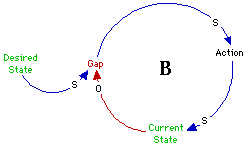
The Desired State interacts with the Current State to produce a Gap. The larger the Gap the stronger the influence to produce Action. The Action taken then moves the Current State toward the Desired State reducing the Gap. When the Action succeeds in moving the Current State to the Desired State the Gap is reduced to zero and there is no more influence toward Action.
The Drifting Goals structure is composed of two balancing loops
which interact in such a way that the activity of one loop actually
undermines the intended balance the other one seeks to achieve.
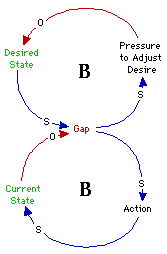
The Desired State interacts with the Current State to produce a Gap. This Gap influences Action intended to move the Current State in the direction of the Desired State. At the same time the Gap influences Action it creates a Pressure to Adjust Desire. This pressure essentially acts as an influence to reduce the Desired State. As the Desired State is undermined it works to reduce the Gap lessening the influence toward Action. The final result of this structure is that it reaches an equilibrium other than what was the initial Desired State.
An Escalation structure is composed of two balancing loops
which interact in such a way as to create a single reinforcing
loop.
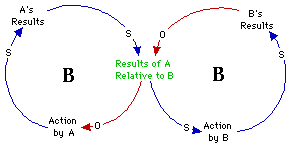
An increase in the Results of A Relative to B
influences more Action by B. An increase in Action
by B enhances B's Results. As B's
Results increase it tends to reduce the Results
of A Relative to B. This reduction tends in influence
more Action by A. Additional Action by
A increases A's Results. The increase
in A's Results then increases the Results
of A Relative to B, and the cycle then repeats.
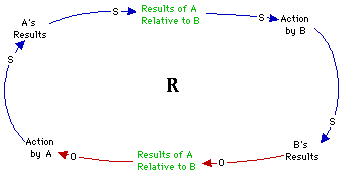
The above redrawn Escalation structure makes its reinforcing nature rather apparent.
The Fixes That Fail structure consists of a balancing loop
and a reinforcing loop. These two loops interact in such a way
that the desired result initially produced by the balancing loop
is, after some delay, offset by the actions of the reinforcing
loop.
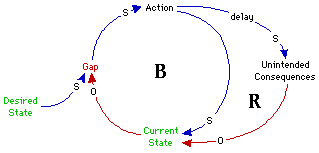
The internal balancing loop operates in the standard balancing loop fashion. The Action that influences the migration of the Current State also influences, after some delay, some Unintended Consequences. These Unintended Consequences subsequently impede the migration of the Current State in the intended direction.
A Growth and Underinvestment structure is simply an elaborated
Limits to Success structure where the slowing action is part of
another balancing loop with an external standard and some delay.
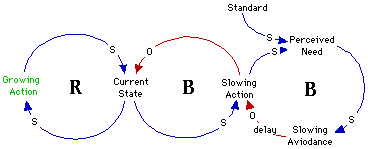
The Growing Action which initiates this structure
influences an increase in the Current State.
The increase in the Current State then influences
more of the Growing Action, producing the reinforcing
characteristic.
As the Current State moves in the desired direction
is also influences the increase in a Slowing Action.
This Slowing Action subsequently impedes the
migration of the Current State in the desired
direction.
This system can be enabled to grow more if the Slowing
Action is reduced. As the Slowing Action
interacts with a defined Standard there is developed
a Perceived Need for action which influences
the development of something which will act as Slowing
Avoidance which will after some delay reduce the Slowing
Action. The annoying part of this structure is the delay
associated with the Slowing Avoidance interaction
with the Slowing Action.
What happens is that the Slowing Action works
in a shorter time frame reducing the Current State
thus reducing the Slowing Action and eliminating
the Perceived Need. As such the system is limited
in its growth because the Perceived Need for
action is actually undermined by the systems own actions.
The Limits to Success structure consists of a reinforcing loop,
the growth of which, after some success, is offset by a action
of a balancing loop.
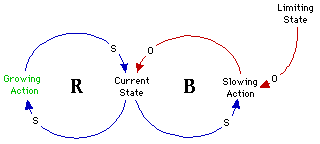
Growing Action interacts with a Current State in such a way that the Current State promotes more of the same Growing Action. As the Current State increases it interacts with some Limiting State to produce a Slowing Action. This Slowing Action then influences the Current State in such a way as to limit the growth promoted by the Growing Action.
A Reinforcing Loop is a structure which feeds on itself to
produce growth or decline.
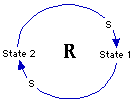
As State 1 increases or decreases State
2 is influenced to move in the same direction. State
2 then influences State 1 to continue
to move in the same direction it is moving.
Because this structure is reinforcing it generally produces an
exponential growth or decline. This exponential change may be
unnoticeable for a period of time until it reaches the a noticeable
range. The structure then seems to change very rapidly causing
one wonders how it began all at once, when in fact it really didn't.
A Shifting the Burden structure is composed of two balancing
loops and a reinforcing loop. It is a very annoying structure
because the two balancing loops act as a single reinforcing loop
migrating the situation in the same direction as the reinforcing
loop. Both structures end up moving the system in a direction
other than the one desired.
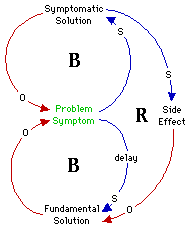
In the above diagram a Problem Symptom is
perceived with multiple possible courses of action. One course
of action, the Symptomatic Solution has an apparent
time frame advantage over the Fundamental Solution
because of other associated delay. As a result the Problem
Symptom influences the application of the Symptomatic
Solution. Application of the Symptomatic Solution
reduces the Problem Symptom which dissolves the
perceived necessity of pursuing the Fundamental Solution.
A failure to implement the Fundamental Solution
ensures that the Problem Symptom will return.
As if this wasn't annoying enough, implementation of the Symptomatic
Solution often influences the development of unintended
Side Effects, which are usually some sort of
dependency. This Side Effect further dissolves
the perception that there is a need to pursue the Fundamental
Solution. The interactions between the Problem
Symptom, Symptomatic Solution, Side
Effect, and Fundamental Solution for
a viscous reinforcing loop which make the problem even more difficult
to resolve.
The Success to the Successful structure consists of two reinforcing
loops which act together as a single reinforcing loop.
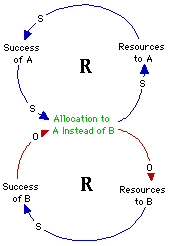
The Allocation to A Instead of B results in
more Resources to A. More Resources to
A enhances the Success of A which enhances
the perception that there should be an Allocation to A
Instead of B. With the Allocation to A Instead
of B there are fewer Resources to B.
Fewer Resources to B impedes the Success
of B which further reinforces the perception that there
should be an Allocation to A Instead of B.
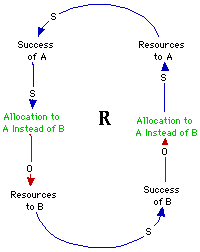
The above redrawn version of the Success to the Successful structure makes its reinforcing nature much more obvious. It is the Success to the Successful structure which is at the heart of so many self-fulfilling prophesies, which are actually the result of unperceived influences on our own part.
The Tragedy of the Commons structure represents a situation
where two or more reinforcing structures are contingent on some
limited common resource.
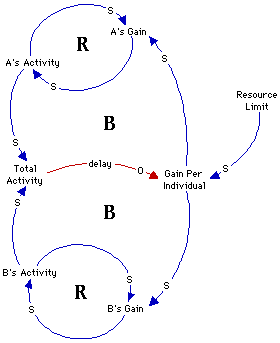
Initially using the resource contributes to each reinforcing loops results. After some time the total activity of the reinforcing structures exceed the capacity of the resource which results in a reduction of the growing action for each of the reinforcing structures. As the Total Activity approaches the Resource Limit it begins to limit the Gain Per Individual essentially limiting the gain of both reinforcing structures.
Please refer to theWay of Systems for a more comprehensive treatment of the archetypes as well as strategies for dealing with them.